Module · Finance and payments
From a balance in the CRM to a confirmed bank transfer
Drivers want their money now, and a fleet can afford neither a lost transfer nor a payout posted twice. The multi-currency payment module runs every payout from the moment the amount leaves the driver's balance in the CRM to the confirmed status coming back from the bank. If the transfer fails, the money returns to the balance on its own.
crm.fleetsoft.pl
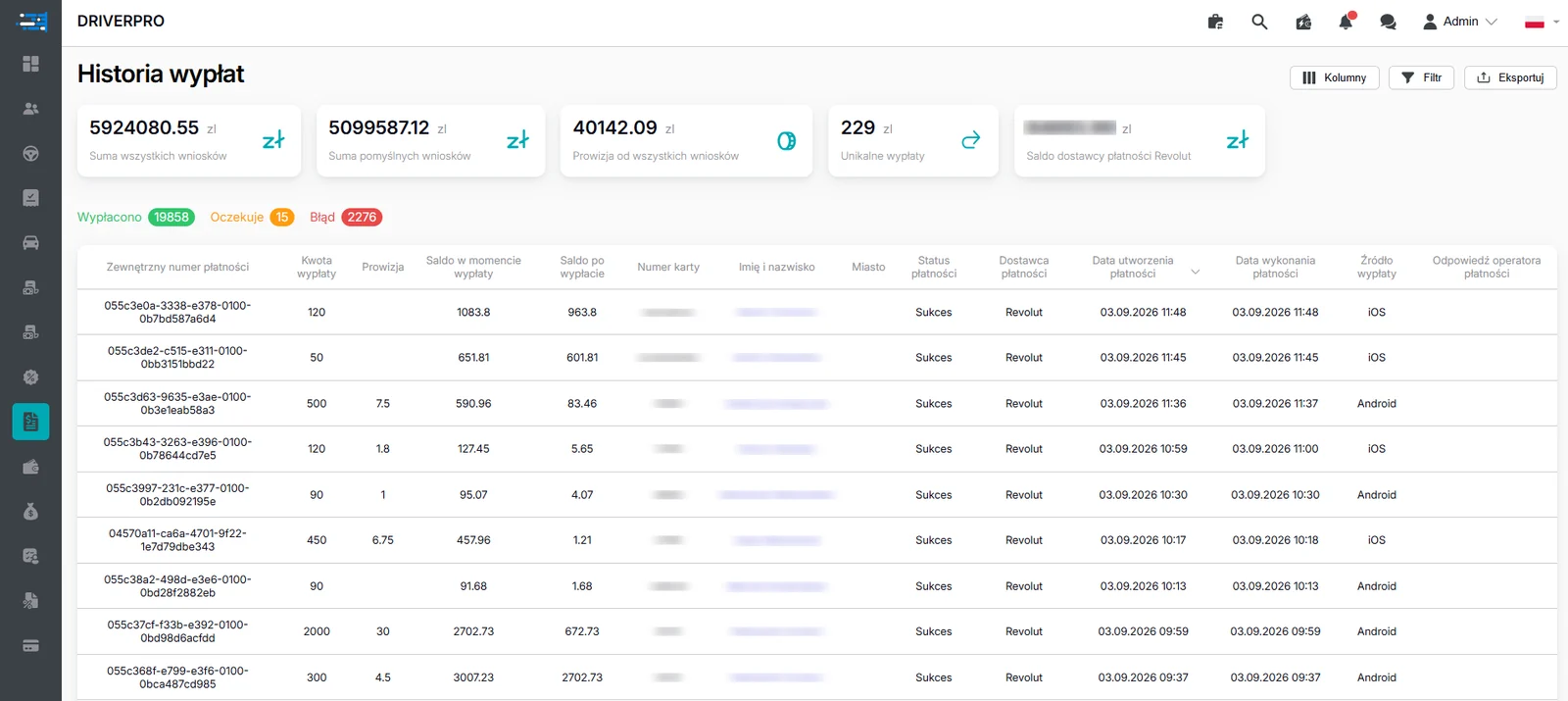
Payout history: every request with amount, commission, Revolut payment status and source (iOS or Android). Personal data hidden.
Why a payout is more than one bank transfer
In a taxi fleet or a courier company, a payout is never a single operation. It is a sequence: take the amount off the driver's balance, charge the commission, send the instruction to the bank, read back the status, close the entry in the books. Let one of those steps happen by hand or in a spreadsheet, and a few weeks later you get a difference nobody in the company can explain.
The multi-currency payment module keeps that whole chain inside the CRM for taxi fleets. Money goes to drivers' personal cards or to IBAN accounts at European banks, handled by Revolut, Zen and ERSTE. Every operation leaves a trail you can show to the driver and to your bookkeeper alike, so the fleet stops answering questions about a missing transfer from memory and answers them with data from the system.
For an owner, the point is that fleet money is protected from both sides: a driver cannot withdraw the same funds twice, and the company is not left with cash hanging somewhere between the CRM and the bank.
How payouts connect to the rest of the system
The payout module does not work in isolation from the rest of the platform. The commission charged on a payout is set in a separate configurator — one panel shared by every scheme, with no need to configure each payment gateway on its own. The balance the money comes from is fed by settlements with ride-hailing aggregators and delivery platforms, and the discrepancy controller makes sure earnings data from Uber and Bolt matches what the driver sees in the app.
On the driver's side it all comes together in a mobile app under the fleet's own brand: current balance, transaction history, bonuses credited, and the option to add a new bank card without asking anyone. Support stops being the middleman for every request to change a card number or check whether a transfer went out.
Frequently asked questions
What happens if the bank rejects a transfer to a driver?–
The system immediately returns both the transfer amount and the commission charged to the driver's balance. No manual correction is needed and nobody has to hunt for the operation in a bank statement — the payout simply returns to the state before the request, and the driver can try again.
Which accounts does driver money go to?+
To drivers' personal cards or to IBAN accounts at European banks. Transactions run through Revolut, Zen and ERSTE, so the fleet pays out through large European financial institutions instead of typing transfers into online banking.
Why can a driver not request two payouts one after another?+
A safety interval of at least 10 minutes applies between consecutive requests from the same driver. It is a guard against transaction spam: dozens of requests sent within seconds can clog the banking channel and delay payouts for the whole fleet.
How does the system know the transfer reached the driver?+
From the integration with i-business 24. The platform queries the bank's API for payment status in real time, using smart requests instead of paid bank notifications. The transaction status in the CRM updates without anyone in bookkeeping touching it.
Does the payout commission have to be set separately for each payment gateway?+
No. All commission schemes are stored and edited in a single configurator tab. You can set a flat, percentage or hybrid commission without repeating those settings in every payment channel.