Module · Communication
Every conversation with your drivers in one window
A driver writes on WhatsApp, a candidate turns up on Instagram, somebody else sends a photo of a document on Telegram. The chat module gathers these channels into a single queue in the CRM and adds context to every conversation: who is writing, which fleet they work in, what their balance and history look like.
crm.fleetsoft.pl
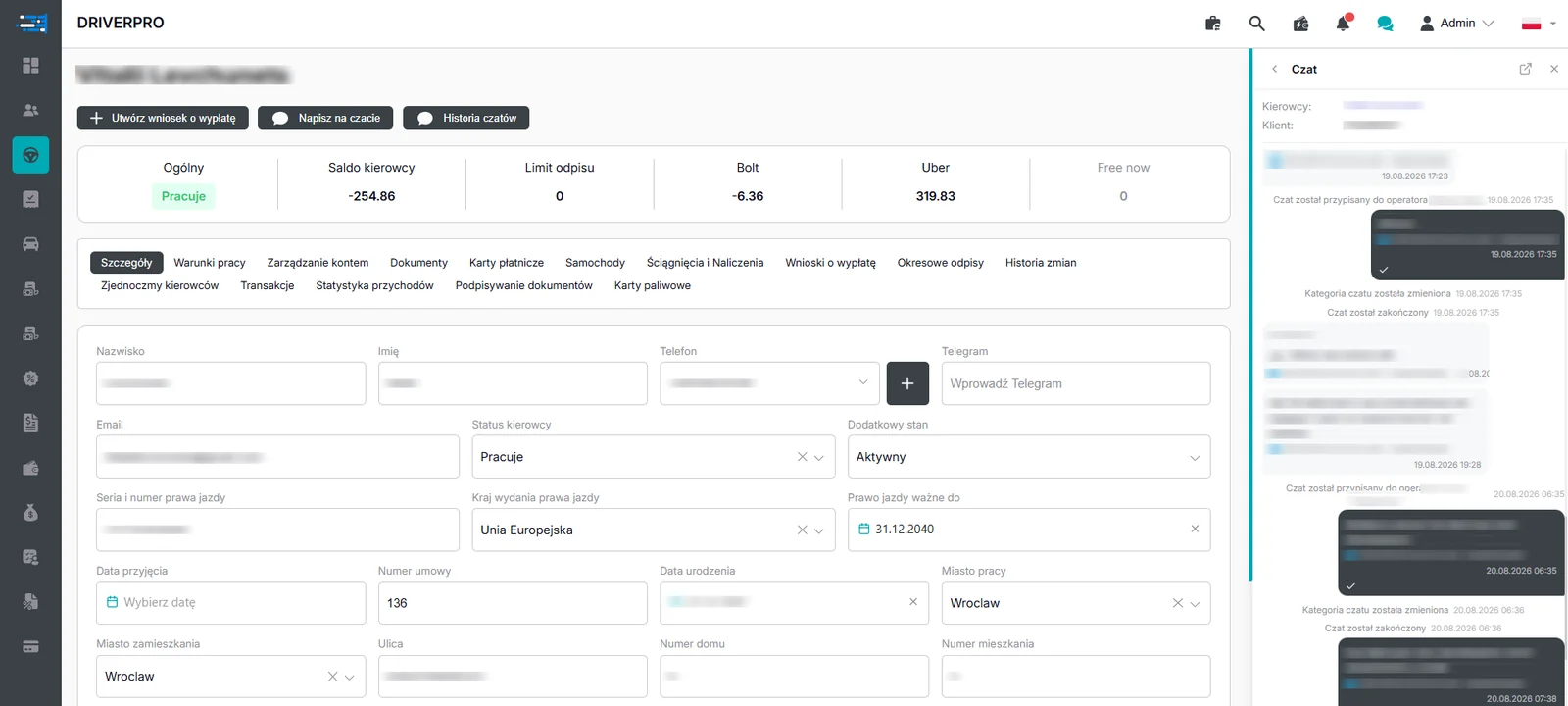
Driver profile with the chat open: details, balance and the whole conversation in one window. Personal data hidden.
One window instead of five apps
Fleet support rarely suffers from a shortage of messages. It suffers from how scattered they are. One work phone with WhatsApp, another with Telegram, plus inboxes on Instagram and TikTok — and nobody in the company can say how many cases are waiting for an answer right now. A case raised in one channel in the evening is often found only when the driver calls for the third time.
This module puts WhatsApp and Telegram chats in the CRM into one shared queue, together with messages from Instagram and TikTok. Operators work in a single interface: they see every unanswered conversation regardless of channel, reply straight from the platform, and never have to remember which app the previous exchange happened in. Instead of five inboxes run by five people, there is one queue with a clear priority.
A conversation with context, not with a stranger
The biggest waste of time in driver support is not writing the answers, it is working out who is actually writing. Before the operator finds out which driver it is, which city they work in and what their settlement looks like, several minutes pass and several questions get asked that drivers cannot stand — because it feels like explaining themselves from scratch at every contact.
Here that stage disappears. The moment a new message arrives, the system searches the database. If the sender is an active driver or a candidate registered earlier, the operator immediately sees the name, the fleet, the balance and the work history. The conversation starts with the case, not with an identity check. For drivers that is the difference between a company that knows them and a company that asks for their surname every time.
Frequently asked questions
Which channels does the chat module handle?–
WhatsApp, Telegram, Instagram and TikTok. Messages from all of these sources go into the CRM and are handled by operators in one shared queue, from a single interface.
How does the system know that one of our drivers is writing?+
The database is scanned with every new message. If the sender is listed in the system as a driver or a registered candidate, the operator immediately sees their name, fleet, balance and work history.
Can conversations be split between offices in different cities?+
Yes. Dialogues are routed automatically to support departments according to the driver's region — for example to the team in Kraków, Warsaw or Wrocław, so that the case is handled by a local manager who knows it.
What exactly does the correspondence history record?+
The whole course of communication with a given contact: the content of the messages, the files sent, photos of documents and the system notifications sent by the platform.
What is the conversation archive good for besides quality control?+
For reconstructing the sequence of events in disputes — for example when a driver and an operator remember differently what was agreed about a settlement, documents or the date a car was to be returned.