Module · Finance and payments
One panel for every payout commission across the fleet
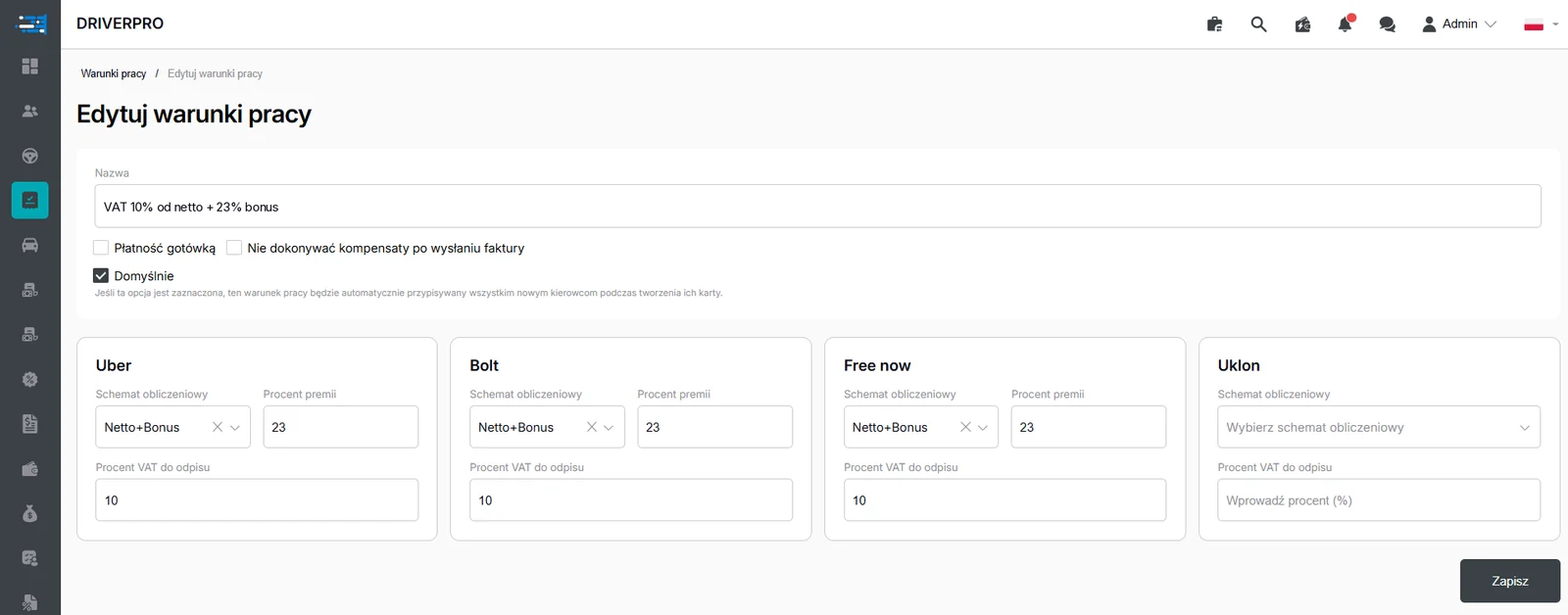
The commission on a payout decides how much the fleet really earns on handling payments and how drivers feel about working with you. The configurator lets you set it in three variants — flat, percentage and hybrid — and keeps every scheme in one place instead of buried in the settings of individual gateways.
crm.fleetsoft.pl
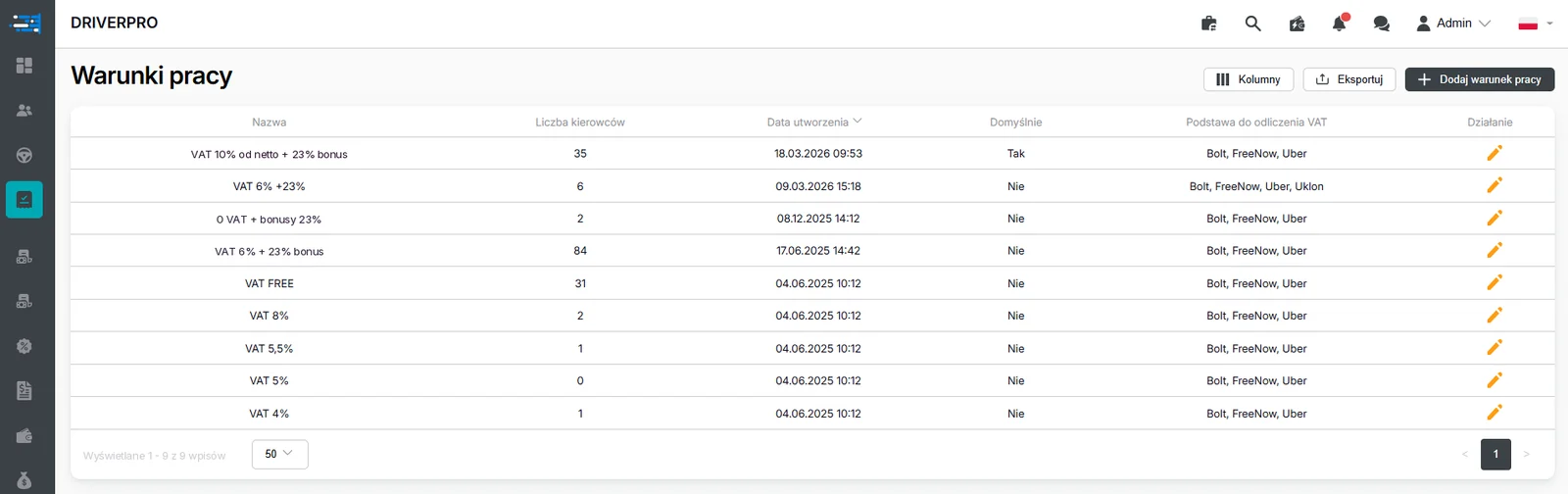
Work terms: settlement schemes with VAT and bonus, and the number of drivers on each
A commission is a business decision, not a technical setting
In a taxi fleet or a courier company, the commission on a payout moves with market conditions, with the costs charged by payment providers, and with how hard the fleet has to compete for drivers. The trouble starts when every change means opening the settings of a separate payment gateway, and the knowledge of what is set where lives in one person's head.
The commission configurator lifts those decisions out of the technical layer and puts them in a panel used by whoever runs fleet finance. The interface follows the standards of fintech platforms, so setting a rate looks like configuring a payment service rather than editing a configuration file.
The result is simple: changing payout terms stops being an implementation project and becomes an operation the fleet performs on its own.
How the hybrid commission is calculated — a configuration example
Take a hybrid scheme with the percentage set to 2% and the flat amount set to 5 zł. The system calculates both values and charges the higher one.
On a 200 zł payout the percentage gives 4 zł and the flat amount is 5 zł, so 5 zł is charged. On a 500 zł payout the percentage gives 10 zł, which is more than the flat amount, so 10 zł is charged. Small payouts therefore do not become unprofitable for the fleet, and on larger amounts the commission scales with the operation.
The figures 2% and 5 zł are only example settings that show how the hybrid works. This is not a FleetSoft price list — the fleet defines the actual rates in its own panel and can change them whenever it sees fit.
Commissions in the payout and settlement chain
A configured commission works in the same chain as the payout module. When a payout is requested, the amount together with the commission leaves the driver's balance in the CRM, and only then does the transaction go to the bank. If the bank rejects the transfer, both entries return to the balance — the amount and the commission — so the driver does not pay for an operation that never happened.
On the fleet side, commissions tie into the rest of the settlements: driver and courier balances are fed by posted earnings from the platforms, and the result of payment operations flows into the fleet's HR and accounting records. The answer to how much the fleet earned on handling payouts in a given period comes from system data rather than from a spreadsheet someone assembled by hand.
Frequently asked questions
How is a hybrid commission different from a percentage one?–
A percentage commission always takes a set percentage of the payout amount. A hybrid one compares the result of the percentage with the flat amount you configured and charges whichever of the two is higher, which protects the fleet from a commission too small to cover the cost of the operation itself.
Does the commission have to be set separately in each payment gateway?+
No. All commission schemes are stored and edited in a single configurator tab, so there is no need to duplicate settings across payment channels or to check whether they still agree with each other.
Are 5 zł and 2% the FleetSoft price list?+
No. They are only example settings that show how each rate type works. The fleet defines the actual commission values in its own panel, depending on the model it uses to work with drivers and couriers.
What happens to the commission if the bank rejects the transfer?+
It returns to the driver's balance together with the payout amount. Two-step posting in the payout module makes sure a failed operation leaves behind neither a charged commission nor a hole in the balance.
Does changing a rate require a developer?+
No. The configurator is part of the interface and was designed to the standards of fintech platforms — whoever runs fleet finance sets the commission type and its value, in the same panel where all the other schemes are visible.